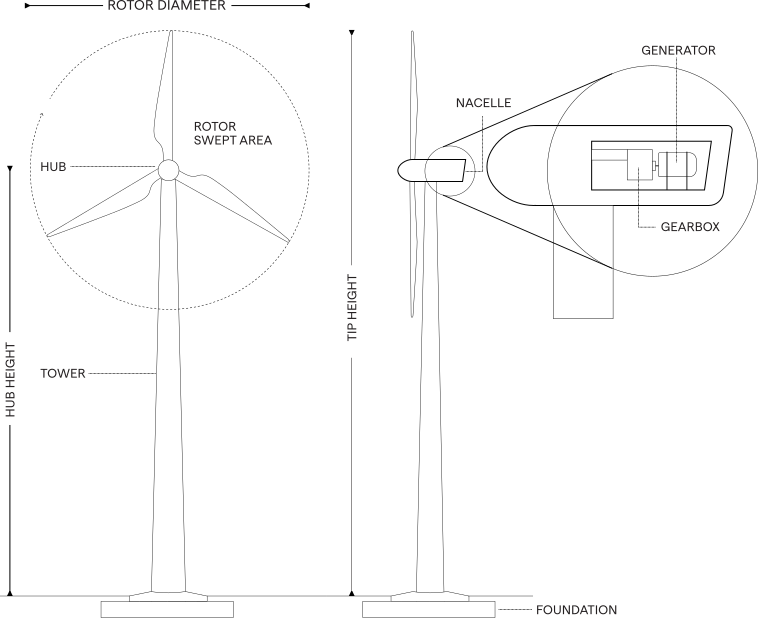
The most noticeable feature of a wind farm are generally its turbines: tall towers with spinning blades. Wind turbines capture wind energy within the area covered by their blades, with their spinning motion driving an electrical generator to produce electricity, which is then transmitted to the grid. A wind farm will generally have multiple turbines.
Wind turbines rotate at speeds ranging from 12 to 25 meters per second – and many modern turbines operate at variable speeds, adjusting in response to changing wind conditions to optimise efficiency.

We handle every aspect of front-end development for large-scale renewable energy projects — from identifying suitable land to project approvals, grid connections to community consultation. And we do all this at no cost or risk to landowners.
We care about what we do and who we do it with. Integrity, transparency and honest conversation are as valuable to our business as the time and capital we invest to make things happen. We seek to create enduring relationships with project partners that ensure mutual success, bringing everyone from landowners to local communities on the journey to transform paddocks into clean, green power.
We help to de-risk and diversify agricultural operations by converting option-to-lease opportunities into long-term income-generating streams – all costs covered. By partnering with us, landowners receive a ‘passive’ income (circa 5 years), long-term financial security and a chance to play a part in transforming the nation’s energy landscape.
As experts in our field, we combine international insights and domestic experience to confidently take projects from conception to shovel-ready status — developing large-scale solar and Battery Energy Storage projects that deliver clean, green energy into our national transmission network.
When it comes to our projects, we’ve done our homework. With a diligence and rigour that’s second to none, we invest the effort to know everything there is to know about our sites –from in-depth site screening and detailed land mapping, to our thorough knowledge of evolving regulations. When the time comes, we’re ready to go to market with no surprises.
Our small team of carefully assembled specialists ensures Avenis is never caught off guard. We’re responsive to market and regulatory changes and quick to disclose when things do. Our ability to be flexible and willingness to communicate openly is what forms the foundations of long-term landowner relationships.
As an independent Australian developer, we’re solely focused on powering the renewable transition on home soil. Backed by the considerable financial strength of local development funding, we commit our own capital to each project we embark on, ensuring the highest level of integrity and a vested, enduring interest in its success.
BESS facilities store electrical energy generated from another source. They improve grid reliability by storing electricity when there is an oversupply or during periods of low demand so that electricity is available when demand is higher. BESS facilities can also stabilise the grid during electricity network disturbances, which helps to reduce the frequency of blackouts and other network supply issues.
Like other utility scale facilities, BESS facilities can generate some sound. The main source of the sound is the cooling fans that regulate the temperature of the individual battery cells. The sound they make is similar to an air conditioning unit or a dull whirring noise. Detailed noise studies are undertaken by specialist consultants during the development process to ensure that any noise generated is within the relevant environmental noise guidelines and limits.
Once operating, BESS facilities must continue to meet strict noise requirements which are set out in the planning process and other relevant noise protocols and/or guidelines.
BESS facilities are designed and constructed to minimise any potential fire risk. During the planning process, we work with the relevant local fire authority to develop an emergency management plan, which ensures the BESS is designed to minimise fire risk and that local emergency services are prepared to respond if fire occurs. Every piece of equipment in a BESS facility is designed and manufactured to meet strict Australian safety standards and to operate in Australian conditions. BESS facilities are also equipped with Battery Management Systems (BMS) that continuously monitor key parameters including voltage, current, power limits, and temperatures. If any of these parameters are outside the range for safe operation, the BMS can shut down the affected parts of the BESS immediately.
A BESS uses proven and safe lithium-ion battery technology – similar to what you would find in your mobile phone or laptop computer - to provide reliable, clean, affordable electricity. To date, independent technical experts have not identified any known direct health impacts associated with BESS facilities.
When a BESS reaches the end of its life (around 30 years), the facility can be decommissioned (shut down). The BESS operator will remove the BESS facility and related infrastructure and rehabilitate the site. This will be a condition of the BESS facility’s development approval from the State government and our agreement with the landowner. During decommissioning most of the materials the BESS is made from can be reclaimed or recycled.
The solar panels will be mounted on horizontal trackers attached to steel piles and motors, which will move the panels in an east-west direction to track the sun throughout the day.
The steel piles will either be screwed or driven into the ground, typically to a depth of 1.5-3m. The panels will be installed in rows with about 5-8 metres space in between them.
Sheep grazing can continue within a solar farm project site which will help maintain the grass levels within the site. Australian studies have shown that solar farms increased grazing quality and significantly boosted the production of vegetation and water retention on farms in arid climates.1
1. Clean Energy Council 2021, Australian Guide to Agrisolar for Large-scale Solar – For Proponents and Farmers
Once it is up and running, the project will make very little noise. The motors that rotate the solar panels in the direction of the sun produce a soft ‘ticking’ noise; and the inverters and substation that the panels are connected to produce a faint ‘hum’. None of the other equipment, including the solar panels, makes any noise whatsoever. A detailed noise impact assessment is completed as part of the planning application for a project to identify and assess any potential noise impacts as well as identify reasonable and feasible noise management and mitigation measures.
No. Solar Panels do not leak chemicals while in use and any chemicals used to manage agricultural use of the land once the panels have been installed will be in keeping with safe farming practices already used on properties throughout the area.
Glare can occur from surfaces that reflect the sun. For example, solar glare can be experienced from water, snow, and even the rural environment and grass. Solar panels are coated with an anti-glare layer which helps to reduce the level of glare from their surface. They are also designed to absorb as much light as possible, this being fundamental to the way they work.
Glare and glint is carefully considered in the Environmental Impact Statement which details anymeasures that will need to be undertaken to minimise glare to any relevant roadways, houses, airstrips etc.
There is no study available on the impact of solar farm developments on property values in Australia. However, a series of studies on the impacts of wind farms, which have higher visibility and noise emissions than solar farms, has shown that land values are very unlikely to be impacted.
The NSW Department of Lands’ analysis of property sales data found that wind farms did not negatively affect property values in most cases.2
Furthermore, a report commissioned by the Office of Environment and Heritage concluded that the available data does not show any significant impact on the value of agricultural properties.3
2. Dupont, R & Etherington, J 2009, Preliminary assessment of the impact of wind farms on surrounding land values in Australia prepared for NSW Valuer General
3. Urbis 2016, Review of the Impact of Wind Farms on Property Values for NSW Office of Environment and Heritage
Solar farms are largely constructed of glass, silicon, steel and aluminium and therefore have very low flammability. Solar farm buildings are constructed of low combustibility or non-combustible materials and vulnerable equipment at the site, such as the substation, is fitted with lightning protection and surrounded by a fenced, gravelled compound.
A Fire Management Plan is used to manage fire risks during the construction period, including measures like stopping work with the potential to cause an ignition during total fire ban days. During the operational phase, fire risks are minimised by maintaining on-site water supplies, low vegetation fuel levels and good firefighting access.
Wind farms are highly compatible with all kinds of farming activities. Livestock grazing and cropping can continue right up to the edge of all turbines, hardstands (paved/hard-surfaced areas) and access tracks. The hardstands constructed for each turbine provide excellent all-weather storage areas for machinery. There are no documented effects on stock nor credible reports of decreases in productivity. In some cases, stock have been seen to use the shade of a turbine during hotter months. Existing farm access tracks and laneways are used, wherever viable, instead of building new access tracks to minimise disruption to farming activities.
At the end of the wind farm’s lifecycle (typically 25-30 years) the wind farm is decommissioned (shut down). The project owner will remove the wind turbines and all above ground structures and rehabilitate the site. This will be a condition of the wind farm’s development approval from the State government and our agreement with the landowners. During decommissioning most of the materials the wind farm is made from can be reclaimed or recycled.
There has been a series of studies onthe impacts of wind farms on local land values which have shown that property prices are not likely to be impacted. The NSW Department of Lands’ analysis of property sales data found that wind farms did not negatively affect property values in most cases. A 2016 report commissioned by the Office ofEnvironment and Heritage found no loss in productivity for rural properties hosting wind farms; and its analysis of property resale data found that all properties hosting wind farms showed capital growth consistent with the broader market.
Like almost anything that moves – the ocean, tractors, cars, the wind itself – wind turbines do create sound. The sound they make can be described as a whooshing or swishing sound. In most cases, it is possible to carry on a conversation at the base of a wind turbine without having to raise your voice. As part of a planning application for a wind farm project detailed noise studies are undertaken by specialist consultants to determine existing noise levels and the wind farm project will be designed and built to comply with the relevant noise standards.
The National Health and Medical Research Council has conducted a comprehensive independent assessment on the scientific evidence on wind farms and human health. They found: “After careful consideration and deliberation, NHMRC concludes that there is currently no consistent evidence that wind farms cause adverse health effects in humans...There is no direct evidence that exposure to wind farm noise affects physical or mental health. While exposure to environmental noise is associated with health effects, these effects occur at much higher levels of noise than are likely to be perceived by people living in close proximity to wind farms in Australia.